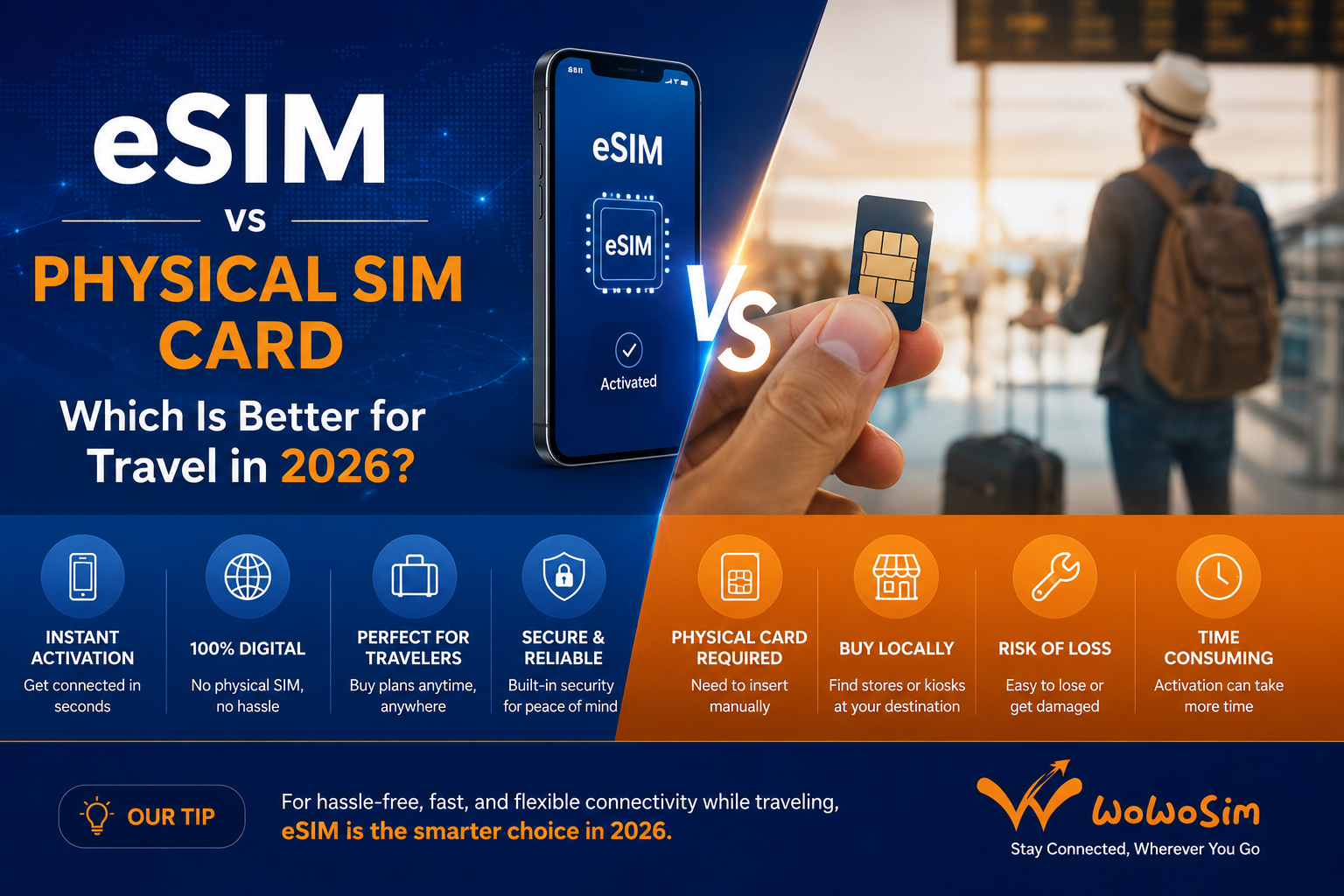
Choosing between an eSIM vs physical SIM is one of the first decisions every international traveler faces in 2026. Both get you connected abroad — but they work very differently, and the wrong choice can cost you time, money, and frustration at the airport. This guide breaks down the eSIM vs physical SIM debate so you can make the right call before your next trip.
What Is a Physical SIM Card?
A physical SIM is the small removable chip you insert into a slot on your phone. You buy it from a carrier store, airport kiosk, or convenience store after landing, pop it in, and your phone connects to the local network. Physical SIMs have been the standard for over 20 years and work in virtually any mobile phone.
The catch: you have to buy one after you land, you need to swap out your home SIM (risking losing it), and in some countries tourists are required to show a passport just to buy one.
What Is an eSIM?
An eSIM — embedded SIM — is built directly into your phone’s hardware. There is no card to insert. Instead, you scan a QR code and the plan downloads to your phone wirelessly in under two minutes. You can buy it at home, activate it before you fly, and arrive at your destination already connected.
Modern smartphones released from 2020 onwards support eSIM, including all recent iPhones, Samsung Galaxy S series, and Google Pixel phones. According to , all iPhone models from the XS onwards are eSIM compatible.
eSIM vs Physical SIM: Side-by-Side Comparison
Setup and Convenience
Physical SIM requires finding a store or kiosk after landing, sometimes waiting in line and showing your passport. eSIM is purchased online in minutes and activates by scanning a QR code — before you even pack your bags.
Keeping Your Home Number
With a physical SIM you usually remove your home SIM to insert the travel SIM, which means missing calls and texts. With eSIM your home SIM stays in your phone and your travel data plan runs simultaneously — you keep your home number active the whole time.
Cost
Airport SIM kiosks are notoriously overpriced. Online eSIM providers like WoWo Sim operate with lower overheads and pass the savings to you. In the eSIM vs physical SIM cost comparison, eSIM almost always wins — especially compared to airport prices.
Security
Physical SIM cards can be removed, lost, stolen, or cloned. eSIMs are embedded in the phone hardware and cannot be physically stolen — making eSIM the more secure option for longer trips.
Device Compatibility
This is where physical SIM still has an edge. Physical SIM works in virtually any phone made in the last 20 years. eSIM requires a compatible device — most phones released from 2020 onwards support it, but older or budget Android phones may not.
When to Choose eSIM vs Physical SIM
Choose eSIM if:
- You have a compatible phone (iPhone XS or newer, Samsung Galaxy S20 or newer, Pixel 3 or newer)
- You want to activate your plan before you fly
- You are visiting multiple countries and want to switch plans easily
- You want to keep your home number active while abroad
- You want to avoid airport queues and overpriced local SIMs
Choose a physical SIM if:
- Your phone does not support eSIM
- You need a local phone number for the country you are visiting
- You are traveling somewhere with limited eSIM provider coverage
Which Countries Support eSIM in 2026?
eSIM is now supported in over 196 countries. WoWo Sim covers destinations across Europe, Asia, the Americas, the Middle East, and beyond. Popular destinations with excellent eSIM support include the UK, France, Germany, Spain, Japan, Thailand, UAE, USA, Canada, and Australia.
Planning a Europe trip? See our for a full plan comparison. Traveling to Japan? Our covers country-specific recommendations. For Southeast Asia, check our for coverage details.
How to Switch from Physical SIM to eSIM
Switching is easier than most people expect. Here is how it works with WoWo Sim:
- Visit wowosim.com and choose your destination
- Select your data plan and complete the purchase
- Receive a QR code by email
- Go to your phone settings and scan the QR code
- Your eSIM is active — your physical home SIM stays untouched
The whole process takes under five minutes. For a full walkthrough see our .
Frequently Asked Questions
Is eSIM better than a physical SIM for international travel?
For most travelers with a compatible phone, yes. In the eSIM vs physical SIM comparison for travel, eSIM wins on speed of setup, price, flexibility, and security. The only reason to choose a physical SIM is if your phone does not support eSIM technology.
Can I have both eSIM and physical SIM active at the same time?
Yes. Most modern phones support Dual SIM — one physical SIM and one eSIM active simultaneously. This means you keep your home number active while using the eSIM for local data abroad.
Does eSIM use more battery than a physical SIM?
No. According to , eSIM uses the same power as a physical SIM card — there is no difference in battery consumption.
Can I reuse an eSIM?
It depends on the provider. WoWo Sim plans are valid for the duration specified at purchase — check the plan details for reuse and top-up options.
What happens if I lose my phone with an eSIM?
Your eSIM is tied to your device hardware and cannot be physically stolen like a SIM card. Contact WoWo Sim support to suspend the plan remotely if your phone is lost or stolen.
The Verdict on eSIM vs Physical SIM
In 2026, eSIM is the better option for the vast majority of travelers. It is faster, cheaper, more flexible, and more secure than buying a physical SIM card at the airport. The only exception is older phones that do not support eSIM hardware.
If you have an iPhone XS or newer, or a Samsung Galaxy S20 or newer, there is almost no reason to choose a physical SIM for your next international trip.
Get connected with WoWo Sim at — plans for 196 countries, instant activation, no airport queues.