
Many first-time visitors to China are confused when they land and open Google Maps. The app loads, but the streets don’t display correctly, live data fails to appear, and route instructions are unavailable. The immediate question becomes: Does Google Maps work in China?
The short answer: Google Maps does not work normally in mainland China.
It is restricted by the Great Firewall, which blocks most Google services. Without a local workaround, you cannot rely on it for real-time navigation, transit, or restaurant locations.
This guide explains in depth:
-
Why Google Maps fails in China
-
Exactly how to access it legally and safely
-
Offline methods that still work
-
Local map applications that outperform Google inside China
-
How GPS behaves differently due to China’s mapping laws
-
Connectivity options such as eSIMs to avoid roaming problems
-
Travel and navigation strategies for first-time visitors
The goal is simple: you will know exactly how to navigate China without frustration.
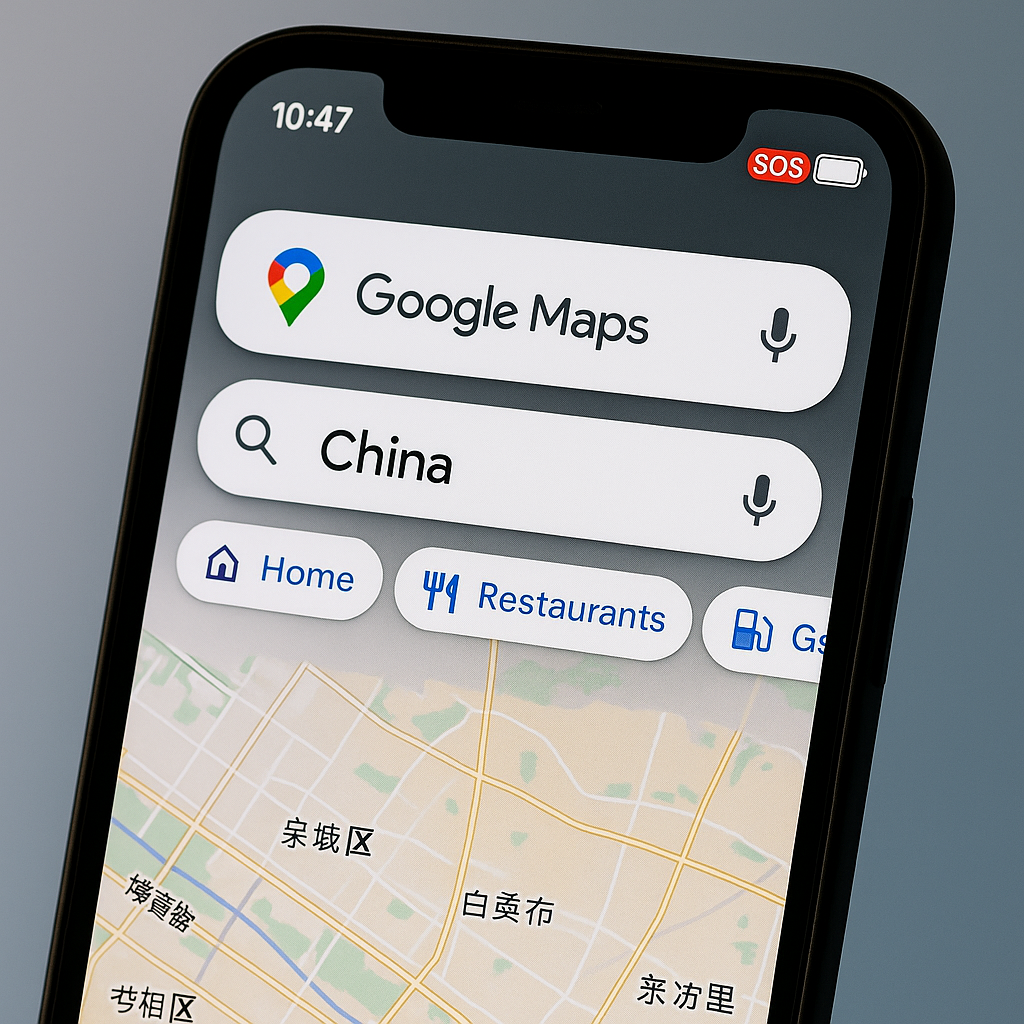
Does Google Maps Work in China?
No. Google Maps is blocked in mainland China due to national censorship policies known as the Great Firewall of China.
Google services that are blocked:
-
Google Maps
-
Google Search
-
Gmail
-
Google Drive
-
YouTube
-
Google Photos
-
Google Play Store (partial)
Because these services are not routed locally, the app can open but cannot retrieve live data.
Important exceptions:
-
Hong Kong
-
Macau
-
Taiwan
In these three regions, Google Maps works normally with full functionality.
Why Google Maps Fails in China
Google Maps depends on Google’s servers. Mainland China blocks access to these servers and reroutes connections through local providers. This results in three main failures:
1. Navigation does not load
You may see:
-
“Directions unavailable”
-
Empty route lines
-
Loading screens that never complete
2. Map tiles display only static data
Roads appear, but:
-
No transit data
-
No live traffic
-
No updated businesses
3. GPS coordinate offset
China uses its own geospatial standard, GCJ-02, not the global WGS-84.
Google Maps does not apply this correction, causing your location to appear:
-
several meters away
-
inside buildings
-
off the road
-
behind or ahead of your real position
This error is not a bug it is required by Chinese regulation.
How to Use Google Maps in China
While Google Maps is unreliable in China, there are three legitimate methods that allow you to use it.
1. Use Google Maps Offline
Offline downloads work without VPN and are 100% legal.
Steps:
-
Before travel, open Google Maps
-
Search a city
-
Select “Download Offline Map”
-
Save entire regions such as:
-
Beijing
-
Shanghai
-
Guangzhou
-
Shenzhen
-
Xi’an
-
Benefits:
-
Turn-by-turn driving
-
Saved pins and favorites
-
Location search
Limitations:
-
No live traffic
-
No transit routes
-
No business reviews
-
No hotel details
Offline mode is reliable for walking and driving, but not ideal for metro or bus routes.
2. Use a VPN
A VPN can restore full Google Maps functions by connecting through servers outside China.
Popular VPN providers:
-
ExpressVPN
-
NordVPN
-
Surfshark
Install VPN before entering China.
Once inside, download pages may fail or require complicated workarounds.
Please note:
-
VPN use is tolerated for travelers
-
It is not recommended to rely on it as your only navigation method
-
VPN speed can fluctuate heavily
Google Maps via VPN is still inferior to local map platforms.
3. eSIM With International Routing
Certain global eSIM providers route traffic outside China by default.
Advantages:
-
Immediate connectivity after landing
-
Google Maps and Gmail access without SIM card shops
-
Avoids SOS mode and roaming failures
An international eSIM keeps your device on neutral infrastructure, bypassing many local restrictions.
Best Alternatives to Google Maps in China
Locals do not use Google Maps. They use high-performance domestic platforms optimized for Chinese cities, taxis, subways, and commercial districts.
Amap (Gaode 高德地图)
Most accurate navigation in China.
-
High GPS precision
-
Correct GCJ-02 coordinates
-
Subway entry/exit guidance
-
Ride-hailing pickup points
-
Restaurant menus
-
Real-time road closures
Key advantage: English interface exists.
This is the app ride-hailing drivers, delivery couriers, and taxi operators use.
Official site:
https://www.amap.com
Baidu Maps (百度地图)
The most widely used map service by Chinese locals.
-
3D building layouts
-
Live congestion heatmaps
-
POI rich areas (malls, markets, schools)
-
Precise public transit algorithms
Strongest features:
-
Smart bus routing
-
Popularity rankings
-
Verified business listings
Limitation:
Interface and voice navigation are primarily in Chinese.
Apple Maps (with Amap backend)
Apple made a licensing agreement in China: Apple Maps uses Amap for data.
This provides:
-
Google-like interface
-
Chinese-level accuracy
-
Silent automatic coordinate adjustment
Benefits:
-
Works without VPN
-
Stable even in metro stations
-
Excellent driving directions
For iPhone users, this is the simplest solution.

Why GPS Feels “Broken” in China
Visitors often believe their phone GPS is malfunctioning. It is not.
The discrepancy is caused by GCJ-02, a coordinate encryption standard mandated by the Chinese government.
What it does:
-
Shifts GPS readings 50–500 meters
-
Obscures real geolocation over sensitive zones
-
Protects military data
Google Maps is not licensed to correct this offset inside mainland China.
Local apps (Amap, Baidu) apply the transformation:
-
Correct pedestrian position
-
Accurate lane guidance
-
Metro entrances
-
Storefront addresses
This is why:
Apple Maps (with Chinese backend) works.
Google Maps does not.
How to Prepare for Navigation in China
1. Install apps before departure
Some app stores restrict downloads once you enter China.
Install:
-
Amap
-
Apple Maps
-
DiDi (China’s Uber)
-
Metro apps (city-specific)
2. Turn on dual navigation backup
Recommended pair:
-
Apple Maps or Amap (primary)
-
Offline Google Maps (backup)
3. Use a reliable data source
Public Wi-Fi:
-
Slow
-
Requires passport login
-
Has hourly timeouts
-
Often filtered
A physical SIM:
-
Works, but fails frequently during roaming
eSIM is the most stable and secure option, especially for business travelers and digital nomads.
Does Google Maps Work in China for Transit?
Public transportation is where Google Maps performs worst.
Chinese metro networks are complex:
-
Multiple entrances and exits
-
Sectorized platforms
-
Interchange zones
-
Walk tunnels longer than 1 km
Amap identifies:
-
Closest entrance
-
Estimated walk times
-
Correct exit numbers
-
Real-time subway statuses
Google Maps cannot interpret this data.
Does Google Maps Work in China for Driving?
Only with:
-
Offline download, or
-
VPN
Even then:
-
Lane guidance inaccurate
-
Tolls mislabeled
-
Ramp exits unclear
Amap is superior:
-
Smart rerouting
-
Detour automation
-
Traffic-police closures
-
Construction alerts
Does Google Maps Work for Food, Hotels, Landmarks?
No.
You will see outdated or blank business data.
China relies on local business platforms:
-
Dianping (reviews)
-
Meituan (restaurants + bookings)
-
Baidu Maps POI indexing
-
Alibaba ecosystem listings
-
Official government tourist databases
Google does not mirror these sources.
How to Stay Connected in Mainland China
Maps are useless without internet.
The most reliable approach is a China-compatible eSIM.
A proper travel eSIM gives:
-
Instant activation
-
4G or 5G access
-
No roaming fees
-
iMessage, WhatsApp, Instagram access
-
International routing compatibility
Frequent travelers prefer it because:
-
No SIM tray
-
No kiosks
-
No ID registration
-
No plan lock-in
It removes the risk of:
-
SOS mode
-
SIM slot failures
-
carrier provisioning errors
An eSIM is the simplest method to ensure all navigation apps work consistently.
Conclusion: Does Google Maps Work in China?
-
Google Maps does not work normally in China.
-
It can only function through offline maps or VPN.
-
The most reliable navigation tools are Amap, Baidu Maps, and Apple Maps.
-
GPS differences come from GCJ-02 geolocation rules, not device problems.
-
The best travel setup is a stable eSIM + a Chinese map app.
If you prepare before arrival, navigating China becomes straightforward and stress-free.