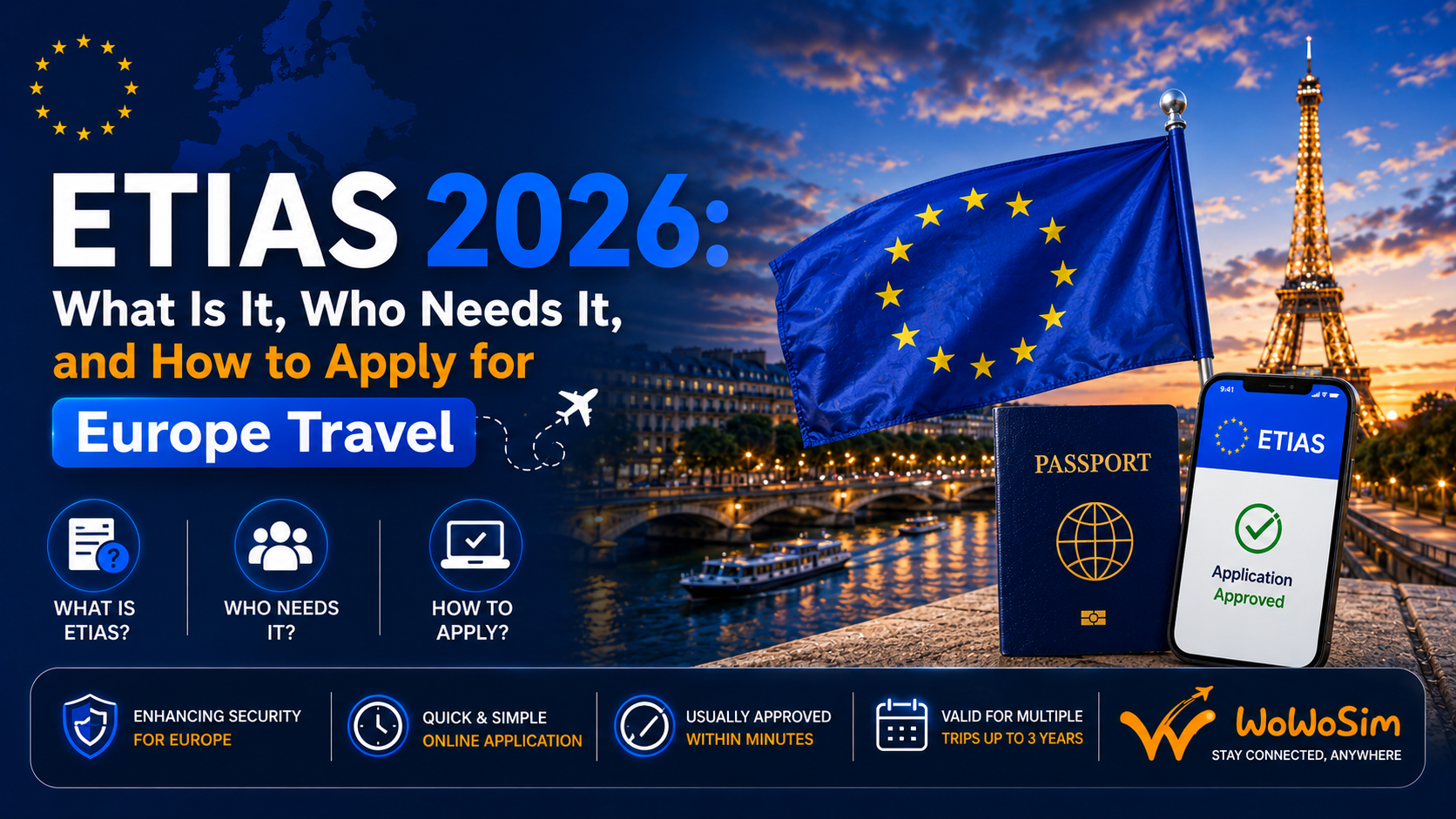
If you’re planning a trip to Europe, you’ve probably been hearing a lot about ETIAS 2026. And if you’re confused about what it is, whether you need it, and when exactly it kicks in — you’re not alone. Millions of travellers from the US, UK, Canada, Australia, and dozens of other countries are asking the exact same questions right now.
The short answer: ETIAS is a new pre-travel authorisation system for the European Schengen Area, launching in Q4 2026. In practice, it works much like the US ESTA or the UK ETA — a quick online check that links your passport to a digital approval before you board your flight. Importantly, it is not a visa, and it does not require any embassy visit.
In this guide, we break down exactly what ETIAS 2026 is, who it applies to, how to apply, how much it costs, and what you need to do right now to prepare. We also cover the new EES system that’s already live at European borders — because the two go hand in hand.
What Is ETIAS 2026?
ETIAS stands for European Travel Information and Authorisation System. Essentially, it is a mandatory pre-travel screening system introduced by the European Union for citizens of countries that currently enjoy visa-free access to the Schengen Area.
Put simply: if you’ve been able to hop on a plane to Paris, Barcelona, or Rome without applying for a visa — you’ll soon need an ETIAS approval before you fly. The EU designed the system to improve border security by screening travellers before they arrive in Europe, rather than only at the border itself.
Furthermore, ETIAS is not a new concept globally. The US has had ESTA since 2009, Canada has eTA, and the UK launched its own ETA in 2023. ETIAS 2026 is Europe’s version of the same idea — and it works almost identically.
ETIAS is not a visa, nor does it replace your passport. There’s no embassy visit required — the entire process happens online. Bear in mind, however, that approval does not guarantee entry; border officers still have the final say at every crossing.
Who Needs ETIAS in 2026?
ETIAS applies to citizens of 59 visa-exempt countries who want to travel to Europe’s Schengen Area for short stays — tourism, business, transit, or family visits of up to 90 days within any 180-day period.
Countries whose citizens will need ETIAS include:
- 🇺🇸 United States
- 🇬🇧 United Kingdom
- 🇨🇦 Canada
- 🇦🇺 Australia
- 🇳🇿 New Zealand
- 🇯🇵 Japan
- 🇰🇷 South Korea
- 🇧🇷 Brazil
- 🇲🇽 Mexico
- 🇦🇷 Argentina
- And 49 other visa-exempt nations
Who does NOT need ETIAS:
- Citizens of EU member states
- Citizens of Schengen Area countries (Norway, Iceland, Switzerland, Liechtenstein)
- Irish passport holders
- Travellers who already hold a valid Schengen visa or national visa
- Children under 18 and adults over 70 — the EU waives the fee for these groups, though they still need approval
If you’re unsure whether ETIAS applies to your passport, the official EU travel portal at travel-europe.europa.eu/etias will have a nationality checker when the system goes live.
Which European Countries Does ETIAS Cover?
In total, ETIAS covers 30 European countries — the 29 Schengen Area member states plus Cyprus. This includes all the major holiday destinations travellers search for every summer:
France, Germany, Spain, Italy, Greece, Portugal, Netherlands, Belgium, Austria, Switzerland, Sweden, Norway, Denmark, Finland, Poland, Czech Republic, Hungary, Croatia, Slovakia, Slovenia, Estonia, Latvia, Lithuania, Luxembourg, Malta, Iceland, Liechtenstein, and more.
One important note: Ireland is not part of ETIAS. Therefore, if your trip includes Ireland, different travel rules apply there and you should check entry requirements separately.
ETIAS 2026 Launch Date: When Does It Actually Start?
ETIAS 2026 is confirmed to launch in Q4 2026 — meaning sometime between October and December 2026. However, the EU has not yet announced the exact date. Officials have confirmed they will publish the specific launch date several months in advance, so travellers have time to prepare.
Here is the critical detail most travellers are missing: even after ETIAS launches, it will not become mandatory overnight. Instead, there will be a transitional grace period of approximately six months, meaning full enforcement is not expected until around April 2027.
The ETIAS rollout in plain English:
| Phase | When | What it means for you |
|---|---|---|
| Right now | May 2026 | ETIAS does not exist yet. No action needed. |
| Launch | Q4 2026 | Portal opens. You can apply voluntarily. |
| Grace period | Q4 2026 – Apr 2027 | You may enter without ETIAS if you meet all other entry requirements. |
| Full enforcement | ~April 2027 | ETIAS is mandatory for all eligible travellers, no exceptions. |
⚠️ Scam warning: As of May 2026, ETIAS applications are not yet open. Any website currently accepting ETIAS applications is fraudulent. The only official application portal will be travel-europe.europa.eu/etias — and it is not yet live.
How Much Does ETIAS Cost?
In terms of cost, the ETIAS application fee is €7 per person — roughly $7.50 USD or £6 GBP. As mentioned above, the EU waives the fee entirely for children under 18 and adults aged 70 and over. However, the €7 fee is non-refundable in all other cases, even if the application is denied or travel plans change after submission.
How Long Is an ETIAS Valid?
Once approved, an ETIAS authorisation is valid for three years — or until your passport expires, whichever comes first. During that three-year window, you can make multiple trips to any of the 30 ETIAS countries without reapplying each time.
Additionally, the 90/180-day rule still applies throughout: you cannot stay in the Schengen Area for more than 90 days within any rolling 180-day period, regardless of your ETIAS status.
One important catch worth noting: if your passport expires during your ETIAS validity period, your ETIAS expires with it. As a result, you will need to apply for a new ETIAS using your renewed passport before your next Europe trip.
How to Apply for ETIAS When It Launches
The ETIAS application will be entirely online — no embassy appointments, no document uploads, and no biometric visits required. Here is what the process will look like when the portal opens in late 2026:
Step 1 — Visit the official ETIAS portal Go to travel-europe.europa.eu/etias. Do not use any third-party websites or paid services.
Step 2 — Fill in the online application form You will need to provide your full name, date of birth, and nationality; your passport details including number, expiry date, and issuing country; your email address; the first Schengen country you plan to enter; and answers to basic health and security declaration questions covering previous criminal convictions and prior visa refusals.
Step 3 — Pay the €7 fee You pay by credit or debit card during the online application process. The payment step takes just a few seconds.
Step 4 — Receive your decision by email The system processes most applications within minutes. In cases requiring additional security checks, processing can take up to 96 hours. The EU sends your approval by email, linked digitally to your passport number — you receive no physical document or sticker.
Step 5 — Travel to Europe Border officers check your ETIAS electronically on arrival. You do not need to print anything or carry any extra paperwork — your passport is all you need.
ETIAS vs. EES: What Is the Difference?
You may have also been hearing about the EES — the Entry/Exit System — which launched on 10 April 2026 and is already operating at Schengen borders today. Many travellers are currently confusing EES and ETIAS, so here is a clear side-by-side breakdown:
| EES | ETIAS | |
|---|---|---|
| What it is | Digital border tracking system | Pre-travel online authorisation |
| Status right now | Live since 10 April 2026 | Not yet live — launching Q4 2026 |
| What it does | Replaces passport stamps with digital fingerprint and photo scans at the border | Screens travellers before they board their flight |
| Who it applies to | All non-EU/non-Schengen nationals | Citizens of 59 visa-exempt countries only |
| Do you apply in advance? | No — the border handles it on arrival | Yes — apply online before you travel |
In contrast to ETIAS, EES requires no advance action from travellers — it all happens at the border. If you’ve already travelled to Europe after 10 April 2026, you will have experienced EES at passport control — slightly longer queues as your fingerprints and photo were registered for the first time. ETIAS, on the other hand, is something you sort at home before your trip even begins.
What Should You Do Right Now?
For now, ETIAS is not live and you cannot apply today. Nevertheless, there are four smart steps travellers are taking to stay ahead:
Check your passport validity. Your passport must be valid for the full duration of your stay in Europe. Moreover, if you’re planning a late 2026 or early 2027 trip, make sure it won’t expire mid-trip — or mid-ETIAS validity window — since both would require a fresh application.
Bookmark the official EU portal. travel-europe.europa.eu/etias is where you’ll apply when the time comes. Save it now and ignore any other site claiming to offer ETIAS applications before the official launch.
Understand whether you need ETIAS or a Schengen visa. If your country does not currently enjoy visa-free access to Europe, you already need a full Schengen visa — in that case, ETIAS does not apply to you at all.
Sort your travel connectivity early. Once your ETIAS is approved and your flights are booked, the next priority is reliable mobile data across Europe — without roaming bill surprises when you land.
Stay Connected Across All 30 ETIAS Countries with WoWo Sim
ETIAS gets you through the border. A WoWo Sim eSIM keeps you connected once you’re there.
Whether you’re exploring the old city in Dubrovnik, navigating Rome without Wi-Fi, or checking Google Maps across the Greek islands — roaming charges across 30 different European countries can add up fast if you’re not prepared. Fortunately, there’s a much smarter way to handle it.
WoWo Sim’s Europe eSIM plans cover 30+ countries on a single plan. There’s no SIM swapping, no local store queues, and no surprises on your bill at the end of the trip.
- ✅ Instant activation before you fly — scan a QR code, done in minutes
- ✅ Coverage across France, Spain, Italy, Germany, Greece, Croatia, Portugal and more
- ✅ Fixed-data plans from 1GB to 50GB — pay only for what you need
- ✅ Keep your home number active for calls while using WoWo data
Explore WoWo Sim Europe eSIM plans → wowosim.com/europe-esim
ETIAS 2026: Frequently Asked Questions
Is ETIAS a visa? No. ETIAS is an electronic travel authorisation, not a visa. Specifically, it is only available to citizens of countries that already travel to Europe visa-free. If you currently need a Schengen visa, ETIAS does not apply to you.
Can I apply for ETIAS right now? No. As of May 2026, the ETIAS portal is not yet open. Consequently, any website accepting ETIAS applications today is fraudulent — avoid them entirely.
Will I need ETIAS for a summer 2026 Europe holiday? No. ETIAS is not required for 2026 travel. The grace period means it will only become fully mandatory around April 2027, so summer 2026 travellers can visit Europe as normal.
Does ETIAS replace my passport? No. You still need a valid passport. The system links your ETIAS electronically to your passport number and border officers verify it on arrival — you carry no extra document.
What if my ETIAS application is denied? The EU will send a written explanation with the reasons for denial. From there, you can appeal the decision or, in most cases, apply for a traditional Schengen visa instead.
Does ETIAS cover the UK? No. ETIAS covers EU and Schengen countries — the UK is not part of it. The UK runs its own ETA system, already live, which is entirely separate from ETIAS. Therefore, if you’re visiting both the UK and Europe on one trip, you may need both authorisations depending on your nationality.
How is ETIAS different from a Schengen visa? A Schengen visa is for citizens of countries without visa-free access to Europe. ETIAS, by contrast, is only for citizens of countries that already travel to Europe without a visa. The two systems cover completely different groups of travellers and should not be confused.
Final Thoughts
Overall, ETIAS 2026 is a meaningful change for millions of travellers who have been crossing into Europe without any pre-registration for years. In practice, however, it is a simple, low-cost, mostly automatic process — similar to the US ESTA that American travellers already use in reverse.
The key things to remember: you don’t need to do anything right now, the fee is just €7, it’s valid for three years, and the application takes just minutes once the portal opens in late 2026. Keep your passport valid, stay away from third-party application sites, and when ETIAS goes live — apply early through the official EU portal and travel with confidence.
And once that approval email arrives? Make sure your data plan is sorted too. Browse WoWo Sim’s Europe plans → wowosim.com/europe-esim
Last updated: May 2026 | Sources: European Union official travel portal (travel-europe.europa.eu), ABTA, AFAR, France Diplomatie